
Introduction
Kanji, one of the three writing systems in Japanese, can be challenging for learners due to its complexity and sheer number. However, the reality is that only a fraction of the thousands of kanji are commonly used in daily life. In Japanese elementary schools, students start with a basic set of 80 kanji in the first grade. These kanji cover essential concepts like numbers, time, nature, and simple actions. Learning these 80 kanji can provide a solid foundation for beginners, making further kanji study much more manageable.
In this article, we’ll introduce these 80 foundational kanji, categorize them for easier understanding, and provide example sentences to help learners grasp their usage. By mastering these first 80 kanji, you’ll find that navigating Japanese text becomes significantly easier.
How Many Kanji Characters Are There in Total?
The total number of kanji characters is vast, with estimates ranging from 50,000 to 85,000. However, most of these characters are rarely used. In daily life and modern usage, a much smaller set of kanji is necessary for literacy:
- Jōyō Kanji (常用漢字): This is the set of 2,136 kanji officially designated by the Japanese government as the most commonly used characters in everyday reading and writing.
- Kyōiku Kanji (教育漢字): As mentioned earlier, these 1,026 kanji are part of the Jōyō Kanji and are taught in elementary schools.
While scholars and historians might encounter a far larger number, the 2,136 Jōyō Kanji covers most kanji seen in newspapers, books, and signs.
The selection of kanji characters for elementary school students in Japan is decided by the Ministry of Education, Culture, Sports, Science and Technology (文部科学省, MEXT). The official list of kanji taught to elementary school students is called the 教育漢字 (Kyōiku Kanji), which includes 1,026 characters. This list was first introduced in 1946 after World War II as part of education reforms aimed at simplifying and standardizing the kanji education system. Here is the list of 1,026 Kyōiku Kanji characters for elementary school students:
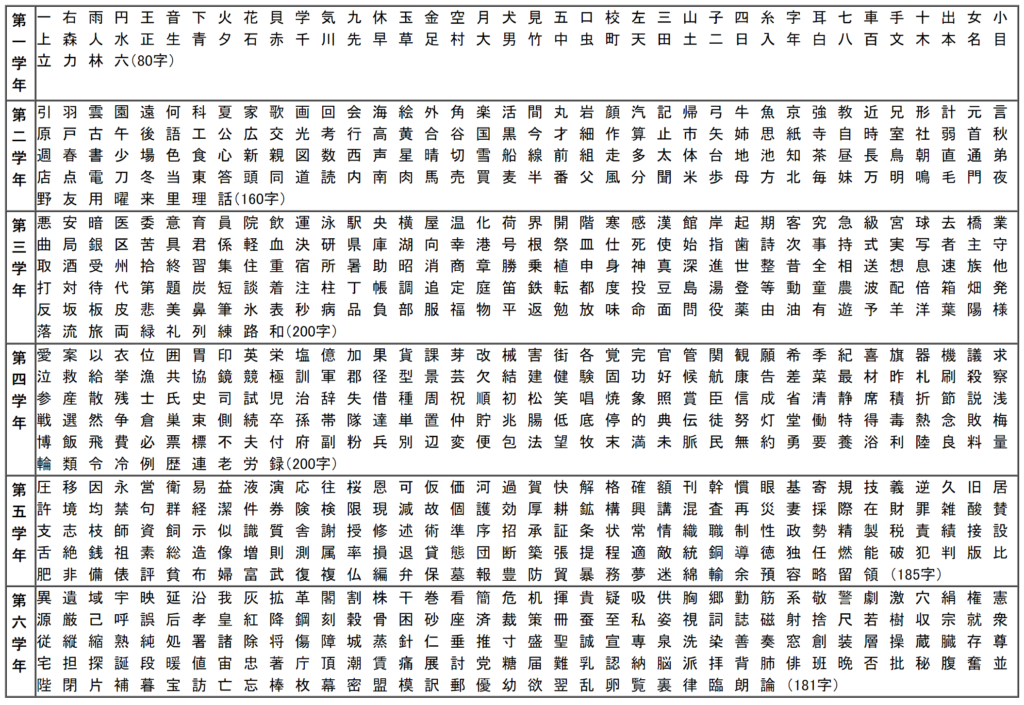
One interesting thing I noticed is that some kanji characters, despite not being used frequently, are introduced in the early grades. For example, the character ‘王,’ meaning ‘king,’ is not commonly used in daily life, as far as I know, yet it’s taught in the first grade. So, I asked ChatGPT for possible reasons why:
Among the 80 Kanji characters that Japanese people learn in the first grade of elementary school, 王 is introduced. I thought that the 80 kanji characters were chosen based on the frequency of the usage, but 王 is not used frequently. How do you think the reason of it?
It’s an interesting observation that 王 (meaning “king” or “ruler”) is among the 80 kanji characters taught to Japanese learners at an early stage, even though it isn’t used as frequently in everyday language. There could be a few reasons for this:
Simplicity and Structure: One key reason could be that 王 is a simple and visually clear kanji, consisting of only three strokes. Early learners of kanji are often introduced to simple characters that can help them build confidence and develop a basic understanding of kanji structure. Teaching simple characters like 王 helps establish a foundation before students move on to more complex ones.
Historical and Cultural Importance: Even though 王 may not be commonly used in daily life, it holds significant cultural and historical value. The concept of kingship and leadership plays a big role in Japan’s past, and many kanji related to hierarchy, such as 国 (country), often incorporate 王. Its presence in the foundational kanji might be more about cultural relevance than frequency of modern use.
Character Composition: 王 is also used as a radical in other important kanji, such as 玉 (tama, meaning “ball” or “jewel”) and 現 (gen, meaning “present” or “current”). Learning 王 early helps learners understand these more complex characters when they encounter them later.
So, while 王 itself isn’t as frequently used, its inclusion is likely due to its simplicity, its cultural significance, and its utility as a building block for other kanji.
The First 80 Kanji Learned by Japanese Students
In Japanese elementary schools, students are introduced to kanji gradually, starting with a carefully selected set of 80 characters in the first grade. These kanji are chosen for their frequency of use and relevance to daily life. Learning them gives students a strong foundation for reading and writing, as they cover essential concepts such as numbers, elements of nature, people, and basic actions.
The 80 kanji can be broken down into the following categories for easier study:
- Numbers (13 kanji)
一, 二, 三, 四, 五, 六, 七, 八, 九, 十, 百, 千, 円 - Calendar (8 kanji)
月, 火, 水, 木, 金, 土, 日, 年 - People (6 kanji)
人, 子, 男, 女, 王 - Body (6 kanji)
口, 目, 耳, 手, 足, 力 - Position (8 kanji)
上, 下, 左, 右, 大, 小, 中 - School & Culture (10 kanji)
学, 校, 先, 生, 字, 文, 本, 名 - Nature (11 kanji)
山, 川, 田, 石, 雨, 夕, 空, 天, 音 - Animal & Plant (8 kanji)
林, 森, 花, 草, 竹, 犬, 貝, 虫 - Verbs (6 kanji)
見, 立, 入, 出, 休 - Life (9 kanji)
白, 赤, 青, 早, 正, 糸, 気, 村, 町
Kanji List by Category with Example Sentences
Let’s delve into each category of the 80 kanji, providing simple example sentences and their English translations to help with understanding and memorization.
Numbers (13 kanji)
- 一 (いち) – one
Example: りんごを一つ(ひとつ)食べました。
English: I ate one apple.
we usually pronounce ‘一’ as ‘いち’ when it is written as a single character. However, its pronunciation changes depending on the context. For example, when written as ‘一つ,’ it is read as ‘ひとつ.’
- 二 (に) – two
Example: えんぴつを二本ください。
English: Please give me two pencils. - 三 (さん) – three
Example: かさが三本あります。
English: There are three umbrellas. - 四 (し/よん) – four
Example: 四つのボールがあります。
English: There are four balls. - 五 (ご) – five
Example: 五人の友だちが来ました。
English: Five friends came. - 六 (ろく) – six
Example: りんごが六つあります。
English: There are six apples. - 七 (しち/なな) – seven
Example: 七時に起きます。
English: I wake up at seven o’clock. - 八 (はち) – eight
Example: ねこが八匹います。
English: There are eight cats. - 九 (きゅう/く) – nine
Example: 九月は秋です。
English: September is in autumn. - 十 (じゅう) – ten
Example: 本を十冊読みました。
English: I read ten books. - 百 (ひゃく) – hundred
Example: 百円ください。
English: Please give me 100 yen. - 千 (せん) – thousand
Example: この町には千人が住んでいます。
English: A thousand people live in this town. - 円 (えん) – yen, circle
Example: これは百円です。
English: This is 100 yen.
Calendar (8 kanji)
- 月 (つき/げつ) – moon, month
Example: 月曜日に学校へ行きます。
English: I go to school on Monday. - 火 (ひ/か) – fire
Example: 火曜日は忙しいです。
English: Tuesday is busy. - 水 (みず/すい) – water
Example: 水曜日に泳ぎます。
English: I swim on Wednesday. - 木 (き/もく) – tree, wood
Example: 木曜日はテニスをします。
English: I play tennis on Thursday. - 金 (かね/きん) – gold, money
Example: 金曜日が好きです。
English: I like Friday. - 土 (つち/ど) – earth, soil
Example: 土曜日に山に行きます。
English: I go to the mountains on Saturday. - 日 (ひ/にち) – sun, day
Example: 日曜日は休みです。
English: Sunday is a day off. - 年 (とし/ねん) – year
Example: 年が明けました。
English: The new year has come.
People (6 kanji)
- 人 (ひと/じん) – person
Example: あの人は先生です。
English: That person is a teacher. - 子 (こ) – child
Example: 子どもが遊んでいます。
English: The child is playing. - 男 (おとこ) – man
Example: 男の人が歩いています。
English: The man is walking. - 女 (おんな) – woman
Example: 女の子が笑っています。
English: The girl is laughing. - 王 (おう) – king
Example: 王さまは優しいです。
English: The king is kind.
Body (6 kanji)
- 口 (くち) – mouth
Example: 口を開けてください。
English: Please open your mouth. - 目 (め) – eye
Example: 目が大きいです。
English: The eyes are big. - 耳 (みみ) – ear
Example: 耳で音楽を聞きます。
English: I listen to music with my ears. - 手 (て) – hand
Example: 手を洗いましょう。
English: Let’s wash our hands. - 足 (あし) – foot, leg
Example: 足が速いです。
English: (He/She) is fast-footed. - 力 (ちから) – power, strength
Example: 力を入れて押します。
English: Push with strength.
Position (8 kanji)
- 上 (うえ) – up, above
Example: 本は上にあります。
English: The book is above. - 下 (した) – down, below
Example: 靴は下にあります。
English: The shoes are below. - 左 (ひだり) – left
Example: 左に曲がってください。
English: Please turn left. - 右 (みぎ) – right
Example: 右のドアを開けてください。
English: Please open the right door. - 大 (おお) – big
Example: 大きな犬がいます。
English: There is a big dog. - 小 (ちい) – small
Example: 小さい猫がいます。
English: There is a small cat. - 中 (なか) – inside, middle
Example: 箱の中にあります。
English: It’s inside the box.
School & Culture (10 kanji)
- 学 (がく) – study, learning
Example: 学校で勉強します。
English: I study at school. - 校 (こう) – school
Example: 校庭で遊びます。
English: I play in the schoolyard. - 先 (さき) – previous, ahead
Example: 先に行きます。
English: I will go ahead. - 生 (せい) – life, birth
Example: 私は学生です。
English: I am a student. - 字 (じ) – character, letter
Example: この字は何ですか?
English: What is this character? - 文 (ぶん) – sentence, text
Example: 文を読みます。
English: I read a sentence. - 本 (ほん) – book
Example: 本を読みます。
English: I read a book. - 名 (な) – name
Example: 名前を教えてください。
English: Please tell me your name.
Nature (11 kanji)
- 山 (やま) – mountain
Example: 山に登ります。
English: I climb the mountain. - 川 (かわ) – river
Example: 川で魚を見ました。
English: I saw a fish in the river. - 田 (た) – rice field
Example: 田んぼで働きます。
English: I work in the rice field. - 石 (いし) – stone
Example: 石を拾いました。
English: I picked up a stone. - 雨 (あめ) – rain
Example: 雨が降っています。
English: It is raining. - 夕 (ゆう) – evening
Example: 夕方に散歩します。
English: I take a walk in the evening. - 空 (そら) – sky
Example: 空が青いです。
English: The sky is blue. - 天 (てん) – heaven, sky
Example: 天気がいいです。
English: The weather is nice. - 音 (おと) – sound
Example: 風の音が聞こえます。
English: I can hear the sound of the wind.
Animal & Plant (8 kanji)
- 林 (はやし) – woods, forest
Example: 林の中を歩きます。
English: I walk in the woods. - 森 (もり) – forest
Example: 森は静かです。
English: The forest is quiet. - 花 (はな) – flower
Example: 花が咲きました。
English: The flowers have bloomed. - 草 (くさ) – grass
Example: 草を刈ります。
English: I cut the grass. - 竹 (たけ) – bamboo
Example: 竹の子を食べます。
English: I eat bamboo shoots. - 犬 (いぬ) – dog
Example: 犬が走っています。
English: The dog is running. - 貝 (かい) – shellfish
Example: 貝を拾いました。
English: I picked up a shell. - 虫 (むし) – insect
Example: 虫が飛んでいます。
English: An insect is flying.
Verbs (6 kanji)
- 見 (み) – see, look
Example: 鳥を見ます。
English: I look at the bird. - 立 (た) – stand
Example: いすの前に立ちます。
English: I stand in front of the chair. - 入 (はい) – enter, put in
Example: 部屋に入ります。
English: I enter the room. - 出 (で) – exit, go out
Example: 家から出ます。
English: I leave the house. - 休 (やす) – rest
Example: ここで休みましょう。
English: Let’s rest here.
Life (9 kanji)
- 白 (しろ) – white
Example: 白いシャツを着ます。
English: I wear a white shirt. - 赤 (あか) – red
Example: 赤い花がきれいです。
English: The red flower is beautiful. - 青 (あお) – blue
Example: 青い空が見えます。
English: I can see the blue sky. - 早 (はや) – early, fast
Example: 早く起きました。
English: I woke up early. - 正 (ただ) – correct, right
Example: 答えが正しいです。
English: The answer is correct. - 糸 (いと) – thread
Example: 糸で布を縫います。
English: I sew the fabric with thread. - 気 (き) – spirit, feeling
Example: 元気ですか?
English: How are you feeling? - 村 (むら) – village
Example: 村に住んでいます。
English: I live in a village. - 町 (まち) – town
Example: 町を歩きます。
English: I walk around the town. - 車 (くるま) – car
Example: 車に乗ります。
English: I ride in a car.
Conclusion
These 80 kanji are fundamental to understanding basic Japanese vocabulary and grammar. They cover essential aspects of daily life, nature, society, and actions, providing a well-rounded starting point for beginners. By learning these characters, Japanese learners will be able to read simple texts, understand basic instructions, and get a feel for the structure of the language.
To efficiently learn these kanji, consider using flashcards, kanji practice apps, and writing them out by hand. Consistent practice and exposure are key to building a solid kanji foundation. Happy studying, and remember that learning kanji is a gradual process—each character mastered is a step closer to fluency!


